
How much does golf course netting cost?
New golf course barrier netting typically runs $80,000 to $300,000 on wood poles and $200,000 to $3 million on steel poles. Replacing the netting on poles you already have typically runs $40,000 to $150,000.
The ranges are wide because courses are. A short run between a fairway and the tennis courts is a different project from a long, tall barrier along a road. These are starting points, not a price list: every system is engineered to its site.
New barrier netting, wood poles
$80,000 to $300,000
The most common system along fairways and property lines.
New barrier netting, steel poles
$200,000 to $3 million
For taller nets, longer runs, and high-wind or high-exposure sites.
Netting replacement on existing poles
$40,000 to $150,000
Starts with an inspection of your poles, cables, and anchors.
What our golf course netting jobs have cost
Price ranges from finished golf course jobs, so you can see where a project lands.
- Palma Ceia Golf & Country Club
Tampa, FL
About 120 ft of barrier netting, 30 ft high, on new steel poles between the course and the tennis courts.
$55,000 to $65,000
- YMCA Par 3 Course
Lakeland, FL
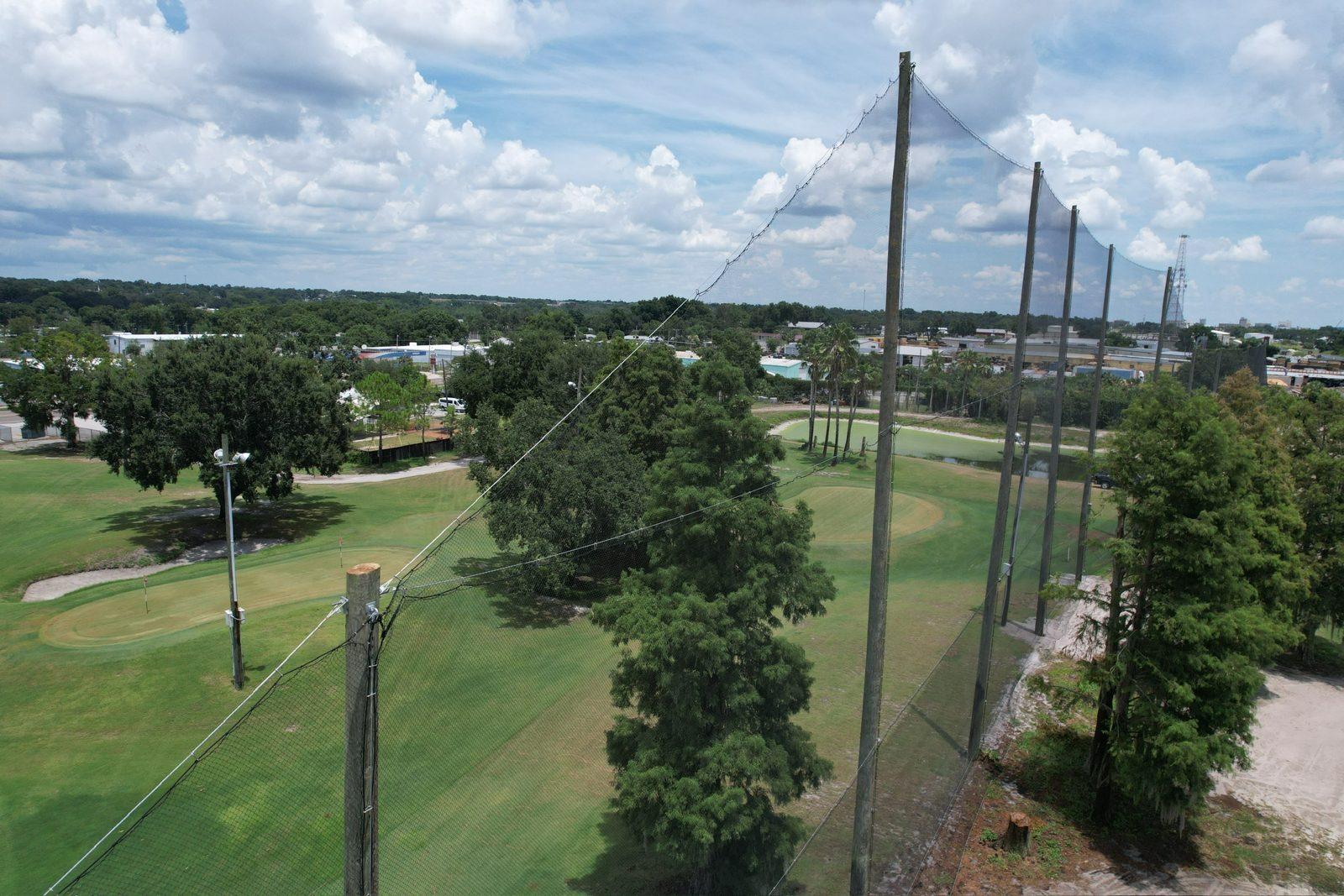
A torn, leaning perimeter net line replaced with new wood poles and new netting along the course edge.
$115,000 to $135,000
Why there is no standard price per foot
Two runs of the same length can be completely different jobs. Double the height and you need bigger poles, deeper foundations, and often stamped engineering. Put the same run on a slope, in rocky soil, or in a coastal wind zone, and the cost changes again. Linear footage is a starting point, not the answer.
What drives the cost of golf course netting
- Linear footage: how many feet of netting the hole or property line needs
- Net height, the biggest driver of pole size, foundations, and engineering
- Pole type: wood or steel
- Soil conditions: rock, sand, clay, or a high water table
- Wind exposure, especially at coastal and open sites
- Access for equipment on a live course, and turf protection
- Engineering and permitting requirements
- Location: crew travel and local labor rates
- New system, or new netting on existing poles
Height, poles, and spacing
Golf course barrier netting typically runs 20 to 80 feet, and sometimes higher near roadways or homes. The right height depends on the hole, where shots come from, and what sits beyond the net.
50 feet on center is a common pole spacing. Wood poles typically reach about 60 feet above grade. Above that, steel becomes structurally necessary and often more cost-effective, and steel poles reach up to 180 feet.
New system or netting replacement?
If your poles, cables, and anchors are sound, new netting on the existing structure is usually the lower-cost path. Replacement starts with an inspection before we specify new mesh. If poles need to go, we tell you first. At the YMCA Par 3 course in Lakeland, the old poles were leaning, so the crew set new wood poles and hung new netting along the course edge.
What's included in a turnkey quote
- Site assessment and measurement
- Stamped engineering drawings (when required)
- Pole procurement and setting (wood or steel, with foundations)
- Cable and hardware installation
- Netting material installation and tensioning
- Final inspection and project handoff
- 5-year full coverage warranty
Permitting is typically handled by the property owner or general contractor. Gorilla Netting provides the documentation needed to support permit applications.
Golf course netting cost questions
How much does golf course netting cost?
New barrier netting on wood poles typically runs $80,000 to $300,000, and steel pole systems run $200,000 to $3 million. Netting replacement on existing poles typically runs $40,000 to $150,000. Shorter runs can land lower: the 120 ft Palma Ceia barrier in Tampa came in at $55,000 to $65,000.
Is there a price per foot for golf course netting?
Not a reliable one. A short, low run on flat ground and the same length at twice the height on a slope need different poles, foundations, and engineering. Linear footage matters, but height, soil, and wind change the number just as much.
How tall does golf course netting need to be?
Golf course barrier netting typically runs 20 to 80 feet, and sometimes higher near roadways or homes. The Palma Ceia barrier is about 30 feet high. When a site needs more height, steel poles reach up to 180 feet.
When do you need steel poles instead of wood?
Wood poles typically reach about 60 feet above grade. Above that, steel becomes structurally necessary and often more cost-effective. Steel also suits high-wind sites and long spans.
Is replacing the netting cheaper than a new system?
Usually, if your poles, cables, and anchors pass inspection. Replacement on existing poles typically runs $40,000 to $150,000. If poles are leaning or damaged, we tell you before quoting. At the YMCA Par 3 course in Lakeland, the old poles had to be replaced along with the netting.
How long does a golf course netting install take?
Most golf installs take 3 to 7 days from crew arrival. Larger projects can take 2 weeks or more, depending on soil, access, and weather. Crews work off ground mats to protect the turf.
Can I get a quote without a site visit?
Often, yes. Photos, a site plan, and the hole or property line you need to protect are enough for a first estimate. A formal on-site check should still happen before the project starts to confirm conditions.