
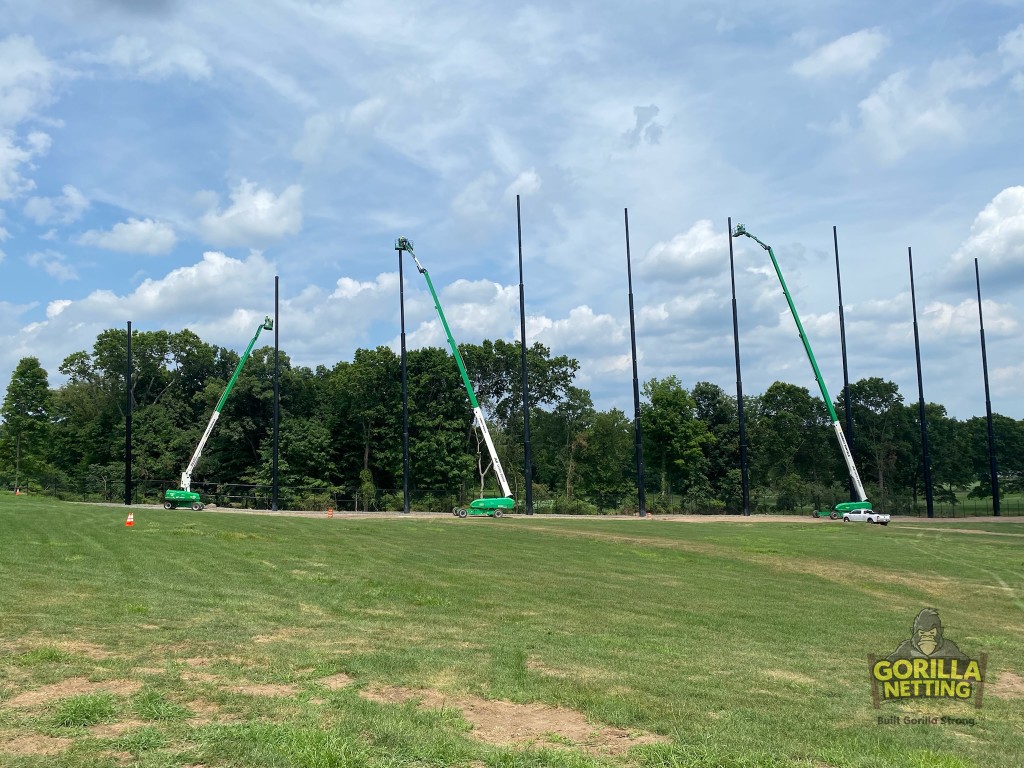
Driving Range Netting Installation
Driving range netting installation is a turnkey job: engineered pole layout, localized wind-load calculations, stamped engineering packet, then crew-set poles, cable, and panels.
Gorilla Netting is a self-performing driving range netting contractor. Own crews handle every netting phase from pole foundations through final walkthrough — no hand-offs, no surprises.
For cost drivers and planning context, see our driving range netting cost guide. For excess-load protection, review our breakaway netting systems.
Who We Are as a Driving Range Netting Contractor
Gorilla Netting LLC is a specialty netting contractor headquartered in Tampa, FL, with field operations out of Campbellsville, KY. We've been designing, engineering, and installing driving range netting systems for 20+ years. Every crew member who walks onto your site works directly for us — ABC STEP Platinum certified, safety-trained, and experienced with the specific demands of large-format golf netting.
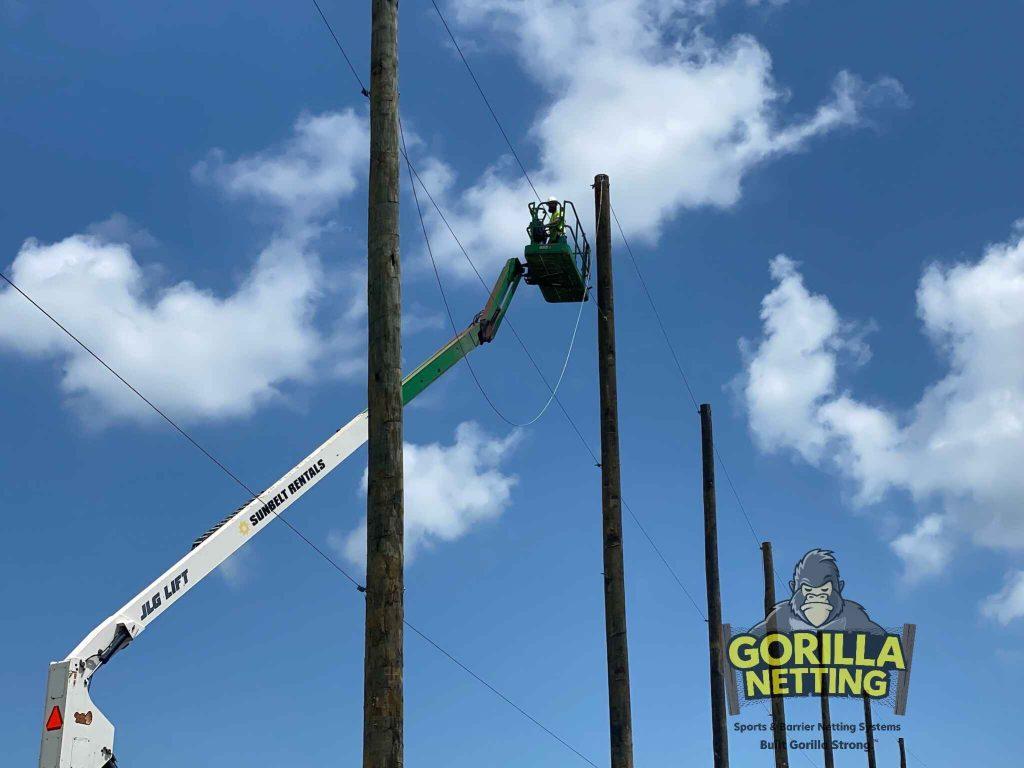
We run our own boom lifts. We carry our own tensioning equipment. We do not broker your project to a regional crew.
That operational model matters when you're setting poles at 120, 150, or 180 feet and tensioning cable under real load conditions. There is no substitute for crews who do this every day.
Our 5-year full coverage warranty backs every installation we complete. That's not a limited warranty. It covers parts and labor — because we stand behind the work.
Looking for a product and system overview first? See our Driving Range Netting overview page.
What's Included in a Turnkey Installation
When you hire Gorilla Netting as your driving range netting installer, here is exactly what's included in the scope:
- Pole layout and staking — field survey of your range layout, pole placement design matched to your dimensions and target heights
- Engineering drawings — stamped drawings available to support your permit application (permitting is the owner's or GC's responsibility; we provide the documentation)
- Foundation work — derrick digger pole foundations within our equipment capability; deeper drilling or large pours coordinated with licensed partners when engineering requires
- Pole setting — full crew with heavy equipment sets wood or steel poles to grade
- Cable hardware installation — top cables, guy wires, and all rigging hardware installed and tensioned
- Net panel installation and tensioning — net panels installed, laced, and tensioned to the correct working load
- Divider netting (if in scope) — bay dividers or target line nets installed simultaneously
- Final walkthrough and punch list — we walk the system with your team before we leave
- Warranty registration — 5-year full coverage warranty issued on completion and sign-off
Netting installation phases are executed by our crew start to finish; licensed-partner work is coordinated by Gorilla when scope requires it.
Plan before you quote
Use the Gorilla Planner to explore layout and cost drivers for driving range netting before requesting a formal estimate.
Pole Options and Engineering
The pole system defines the project. We work with two primary systems:
Wood Poles
Standard wood poles reach 60 feet above grade. They're cost-effective for shorter ranges and facilities where aesthetics favor a traditional look. We handle procurement, treatment specification, and setting. Wood poles are ideal for ranges up to approximately 250–275 yards where height requirements stay within the 60-foot envelope.
Steel Staged Poles
Steel staged poles reach heights up to 180 feet. These are the right call for long ranges, high-wind environments, and facilities where a ball flight at peak trajectory requires containment well above what wood can achieve. Staged steel systems require more detailed engineering review and longer lead time on fabrication, but they deliver a structure built to stand for decades.
Both systems are engineered to your specific site. We account for soil bearing capacity, wind load, and local code requirements. Stamped engineering drawings are produced for every project and provided to support your permitting process.
Have a specific height or span requirement that doesn't fit a standard template? Open Gorilla Planner and tell us what you're working with.
Netting Material Selection
Net selection is driven by your range's use pattern, climate, and performance targets. We specify netting based on:
- Mesh size — smaller mesh for shorter irons and chip zones; larger mesh for long-ball containment
- Twine weight — heavier twine for high-volume ranges taking daily abuse from range balls
- UV resistance — critical for ranges in high-UV markets in the Southwest and Florida
- Border rope and lacing — border rope gauge and lacing pattern affect tensioning behavior and long-term shape retention
We source from established manufacturers and specify the material that matches the structural system. You don't pick a net off a shelf — we match the net to the pole and cable system so the entire assembly performs as designed.
Our optional Breakaway Netting System is worth considering for any installation where storm loading or extreme conditions could otherwise damage the pole structure. Panels release under excess load and reattach without tearing, saving thousands in potential structural damage.
Project Timeline
A standard driving range — approximately 300 yards long by 200 yards wide with a 60-foot net height — runs an average of 14 daysfrom crew mobilization to sign-off. That's based on normal soil conditions, standard wood-pole systems, and no material delays.
Steel staged-pole systems take longer post-engineering review. Fabrication lead times, additional engineering review cycles, and the complexity of setting tall steel structures add time to the schedule. We scope timeline expectations during the estimating phase so there are no surprises when your crew shows up.
We build schedules around facility operations wherever possible. If you're running a range while we install, we coordinate phases to minimize disruption.
Why Hire a Specialist Contractor
General contractors build buildings. We build netting systems. That distinction matters.
Driving range netting installation requires:
- Pole-setting experience — setting a 120-foot steel pole in auger-drilled concrete requires crew experience and the right equipment. An inexperienced crew creates a structural liability.
- Tensioning knowledge — net panels tensioned incorrectly sag, deform, and fail early. The tension across a cable-supported system must be calibrated to the span and load.
- Netting-specific engineering — driving range netting loads are different from building loads. Wind-on-net calculations, pole moment, and cable catenary behavior require engineers who work in this space.
- Warranty accountability — when something goes wrong with a general contractor's netting subcontract, accountability disperses. When you hire Gorilla Netting directly, we own the outcome — and our 5-year warranty puts that in writing.
We've executed projects nationally and internationally, including at facilities where the stakes for getting it right are high.
Project Portfolio
We've installed driving range netting systems across every climate and facility type. A few examples from our portfolio:
- Kigali Golf Resort & Villas — Kigali, Rwanda — modern steel poles with high-strength polyester netting system, extending play time and delivering a safer, more durable environment for golfers at an international resort facility
- Darlington Golf Course — Mahwah, NJ — driving range transformation using modern steel poles and our breakaway netting system, creating a safer and more durable golfing environment
- Lake Linder Country Club — Florida — custom driving range netting repair and drainage barrier netting to prevent balls from entering an adjacent creek
View Our Projects to see the full range of completed installations.
FAQ: Driving Range Netting Installation
- What does a turnkey driving range netting installation include?
- A turnkey installation from Gorilla Netting covers the complete scope: pole layout and staking, engineering drawings, pole foundations (derrick digger within capability, or coordinated drilling partners when deeper), pole setting, cable hardware installation, net panel installation, divider netting if required by your design, tensioning, a final walkthrough with your team, and warranty registration. We hand you a finished, operational netting system — not a partially completed scope waiting on another contractor.
- How long does driving range netting installation take?
- A standard driving range — approximately 300 yards long, 200 yards wide, with a 60-foot net height — averages 14 days from crew mobilization to sign-off. Larger systems using steel staged poles at heights above 60 feet take longer, particularly after engineering review and fabrication. We provide timeline estimates specific to your project scope during the quoting phase.
- Do you install driving range netting nationwide?
- Yes. Gorilla Netting mobilizes driving range netting crews to project sites across the United States and internationally. Our primary operations run out of Tampa, FL, and Campbellsville, KY. We've worked across the continental U.S., Hawaii, and abroad. Distance is not a limiting factor.
- How do I get a contractor quote for driving range netting?
- Share your range dimensions (length, width, target net height), your pole preference if you have one, and photos of the site. We work from that information to build a scope-based project quote. You don't need to have everything figured out before contacting us — we'll ask the right questions. Remote estimating is valid for most projects; we don't always need a site visit to produce an accurate quote.
Built Gorilla Strong.®