
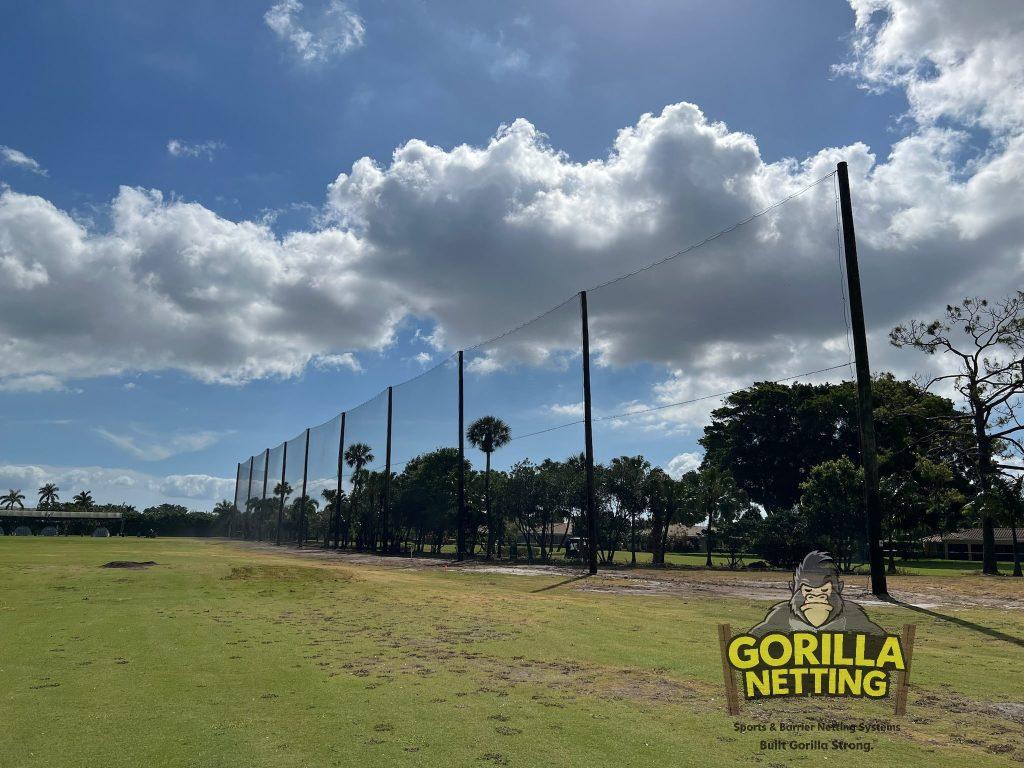
Driving Range Netting Installation in Florida
Hurricane-rated systems engineered for Florida's UV, humidity, and wind load requirements.
Gorilla Netting is headquartered in Tampa, FL. We designed our first systems for this environment. Florida is the hardest state in the country to build outdoor netting that lasts. UV index routinely exceeds 10. Coastal salt air attacks hardware. Daily summer thunderstorms deliver repeated wind loading. And in many counties, hurricane wind-load engineering isn't optional. It's a permit requirement.
We build driving range netting systems across Florida that meet these demands. Tampa, Orlando, Jacksonville, Miami, Fort Lauderdale, Sarasota, Tallahassee, and every market in between. Our crews handle the full scope: engineering, pole setting, net installation, start to finish, with our own crews.
Florida's Climate Is the Hardest Driving Range Environment in the Country
Most states have one or two demanding environmental factors. Florida has all of them, simultaneously, at higher intensity than almost anywhere else in the US.
Hurricane Wind Load Engineering
Florida's wind-load requirements are not advisory. In many coastal counties and wind-exposure zones, Miami-Dade, Broward, Palm Beach, Pinellas, Hillsborough, and others, netting structures require wind-load engineering with stamped drawings. We provide those. Hurricane wind loads dictate pole sizing, foundation depth, cable specifications, and connection hardware. A system designed to standard inland wind assumptions will fail in Florida coastal conditions. We don't guess at load requirements. We engineer to them.
UV Index 10+ Year-Round
Florida's UV index regularly exceeds 10 and does so for a longer portion of the year than any other state in the continental US. Unprotected netting fiber degrades faster here than anywhere else. Material selection is the single most important long-term maintenance decision a Florida facility can make. We specify materials that match the UV exposure reality of the site, not what's cheapest to install.
Coastal Salt Air and Hardware Corrosion
Salt air doesn't just cause surface rust. It initiates galvanic corrosion in hardware systems, clips, cables, turnbuckles, anchor plates, that can compromise structural integrity before the netting itself shows wear. For facilities on or near the coast, Tampa Bay, the Gulf Coast, the Atlantic Intracoastal, the Keys, hardware is specified for salt-air exposure. Standard galvanized hardware is not adequate within several miles of tidal water.
Daily Summer Thunderstorms
Florida's convective season runs from late May through mid-October. Daily afternoon thunderstorms with rapid wind shifts and gust fronts are a consistent load source for netting structures. Systems designed with this repeated loading in mind use hardware and attachment methods that don't loosen or fatigue under regular wind cycling.
Breakaway Netting Systems - Built for Florida Wind Events
Driving range poles and cables are the most expensive structural component in your netting system. Breakaway netting is specifically engineered to protect that investment.
Our breakaway netting systems use patented carabiner clip technology that allows netting panels to detach safely when excess wind load is applied. The panels break away. The poles and cables do not. After a storm passes, panels are reattached without tears in the net or broken border ropes.
Without a breakaway system, a severe wind event that exceeds design load can transfer the full force of the netting load to the poles, resulting in structural collapse that damages the most expensive components of your system and, in some cases, adjacent property.
Breakaway systems are not universally required by Florida code. But in wind-prone zones, and virtually all of coastal Florida qualifies, they represent sound engineering practice and protect a facility's capital investment from an event that is, in Florida, a matter of when rather than if. We strongly recommend them for Florida driving range installations in exposed coastal and high-wind areas.
For a full explanation of how breakaway systems work, see our breakaway netting systems page.
Driving Range Netting Services Available in Florida
We provide full turnkey driving range netting installation across Florida. Engineering, pole setting, netting, and warranty, all from one contractor.
- Driving range netting: Full and partial range systems. Divider netting, perimeter netting, practice enclosures. Wood or steel poles up to 180' staged height. Most installs take 3 to 7 days, and larger systems can take 2 weeks or more.
- Breakaway netting systems: Patented panel breakaway technology. Wind-event protection for poles and cables. Reattach without net damage.
- Pole setting and foundations: Foundation design, engineering, and pole embedment. Wood, steel, or composite. Sized to Florida wind-load requirements by zone.
- Golf netting enclosures: Indoor/outdoor hitting bays, fully enclosed practice facilities, simulator-compatible enclosures.
- Golf course barrier netting: Property line barriers, road and residential adjacency systems, cart path containment.
Netting Materials for Florida Driving Ranges
Material selection for Florida is not generic. Here is what we specify and why.
UV-treated / tarred nylon remains the workhorse for Florida driving range applications. High tensile strength, good impact absorption from golf ball strikes, and UV treatment that extends outdoor service life significantly. Correctly treated nylon holds up in Florida UV conditions far better than untreated alternatives.
Polyesteris a strong choice for large perimeter and downrange netting panels where inherent UV resistance and low water absorption matter. Polyester doesn't absorb moisture. It holds tension better over time in Florida's humid conditions.
Dyneema / UHMWPEis the premium material for Florida facilities that want the longest service life and the lowest long-term maintenance load. Dyneema is essentially immune to UV degradation and moisture. It performs at the highest level in coastal environments where salt air is a factor. Near-invisible sightlines make it well-suited to facilities where aesthetics matter. It costs more upfront, and saves on replacement costs over the system's lifespan.
Hardware for all Florida coastal installations is specified for salt-air resistance. Stainless steel and marine-grade hardware on exposed components. We do not use standard galvanized hardware in coastal environments.
The Tampa HQ Advantage
Gorilla Netting is headquartered in Tampa, FL. We didn't adapt our systems for Florida after the fact. We built them here. Our crews are in the state. Mobilization times are faster than any out-of-state contractor, and our familiarity with county-level permitting documentation, Florida Building Code wind-load zones, and coastal construction requirements is direct, not theoretical.
When your project is in Florida, you're not dealing with a company that occasionally deploys to the Southeast. You're working with the team that built its operation here.
Permitting and local authority coordination is the owner's or GC's responsibility. We supply the engineering drawings, stamped calculations, and material specifications your permit package requires. Remote estimating is fully valid. Accurate quotes are produced from site dimensions, location/county, photos, and aerial imagery.
Frequently Asked Questions - Florida Driving Range Netting
- Does Gorilla Netting install driving range netting in Florida?
- Yes. Gorilla Netting is headquartered in Tampa and installs driving range netting statewide: Tampa, Orlando, Jacksonville, Miami, Fort Lauderdale, Sarasota, Tallahassee, and throughout Florida. We self-perform all netting installation with our own crews. All installations are backed by a 5-year full coverage warranty.
- What wind load requirements apply to Florida driving range netting?
- Wind load requirements vary by county and wind-exposure zone under Florida Building Code. Many coastal counties, including Miami-Dade, Broward, Palm Beach, Pinellas, and others, require engineered stamped drawings for permanent netting structures. We provide wind-load engineering and stamped drawings as part of the project scope. Your county and exposure zone determine the applicable load category; we identify that at the start of every Florida project.
- Are breakaway netting systems required in Florida?
- Breakaway systems are not universally mandated by Florida code. However, in wind-prone and coastal zones, which includes the majority of Florida's coastline and high-exposure inland areas, they are strongly recommended. A breakaway panel system converts a potential catastrophic pole failure into a re-hanging job. The poles and cables, the most expensive structural components, are protected. After a storm, panels are reattached without damage to the net or border ropes. For Florida driving range installations in exposed locations, we recommend breakaway systems as a standard engineering practice.
- How do I get a quote for Florida driving range netting installation?
- Provide your site dimensions (range length, width, target netting height), your location and county (county matters for wind-load zone determination), and photos or aerial imagery of the site. Remote estimating is fully valid. We produce accurate quotes without requiring a site visit. A site visit is available when the project complexity warrants it. Get a quote or call us to get started.
See our breakaway netting systems page and the Florida sports netting overview for more detail on how we approach Florida wind events.
Built Gorilla Strong.® | 5-Year Full Coverage Warranty | US-Based · Global Mobilization | Self-Performing Netting